


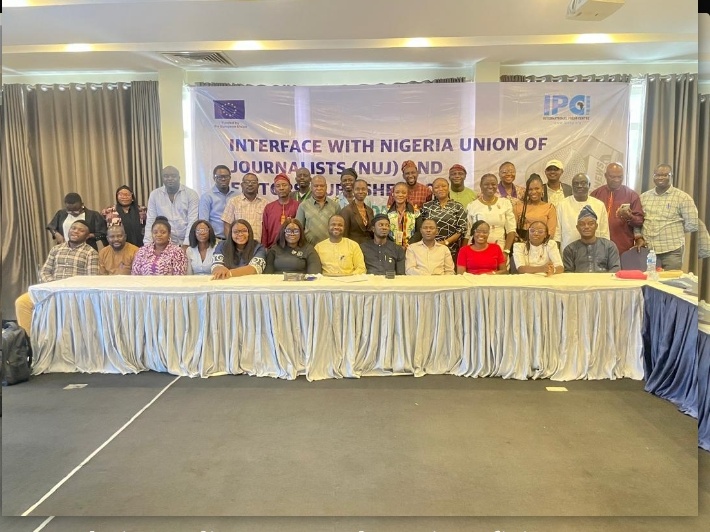
Online publishers, editors, and journalists have been urged to deepen accountability reporting and strengthen digital fact-checking mechanisms ahead of the 2027 general elections in order to restore public trust in democracy.
The call was made during a workshop organized by the International Press Centre (IPC) with support from the European Union, where media experts emphasized the crucial role of the press in bridging the gap between political promises and democratic delivery.
Speaking at the a one day event held in Ibadan with the theme,”nterface with NUJ on professional and democratic accountability journalism ahead of the 2027 general elections.” Dr. Taiwo Adisa, General Editor Nigeria Tribune Newspaper decried a growing global disillusionment with democratic governance, driven by a contrast between campaign commitments and governance outcomes, a sentiment he noted is felt across both mature and emerging democracies.
Referencing the 2005 UN World Summit declaration of democracy as a “universal value,” Dr. Adisa observed that while democracy is practiced in over 190 countries, citizen satisfaction varies widely. However, he maintained that democracy remains the superior model for safeguarding individual liberties and citizen participation.
“Luckily, we have been charged with the responsibility of auditors, who look through the books; as gatekeepers, who filter those that make it into the house; and as the ombudsman, who are to hold the actors to account,” Dr. Adisa stated.
He challenged editors and publishers to pivot away from event-driven and personality-centric coverage, advocating instead for issue-based journalism that prioritizes the concerns of women, youth, and vulnerable populations while tracking political manifestos.
In a session titled “Integrating Fact-Checking for Democratic and Accountability Reporting,” media resource expert Mr. Olusola Oludiran warned of a rapidly degrading information ecosystem flooded with misinformation, disinformation, and malinformation.
Oludiran noted that false narratives spread rapidly because they are designed to be emotionally charged and sensational, posing a direct threat to credible elections and democratic governance.
“False information can trigger violence, undermine public trust, distort electoral choices, and destroy reputations within minutes. The cost of one unverified story can be far greater than the time it takes to verify it,” Oludiran cautioned.
To mitigate these risks, he urged newsrooms to establish dedicated internal fact-checking desks ahead of the 2027 polls and trained participants on digital verification tools, including:
Google Fact Check Explorer for verifying public claims and statements.
InVID & TinEye for reverse image and video verification.
Cross-referencing claims against primary data sources and expert documentation.
Participants commended the IPC and the European Union for the timely training intervention, pledging to embed rigorous verification routines into their daily editorial workflows to safeguard the integrity of the upcoming electoral process.
Would you like me to adjust the tone, focus on a specific aspect (such as the 2027 elections or digital tools), or tailor this report for a specific publication format (e.g., broadcast or online blog)?
