


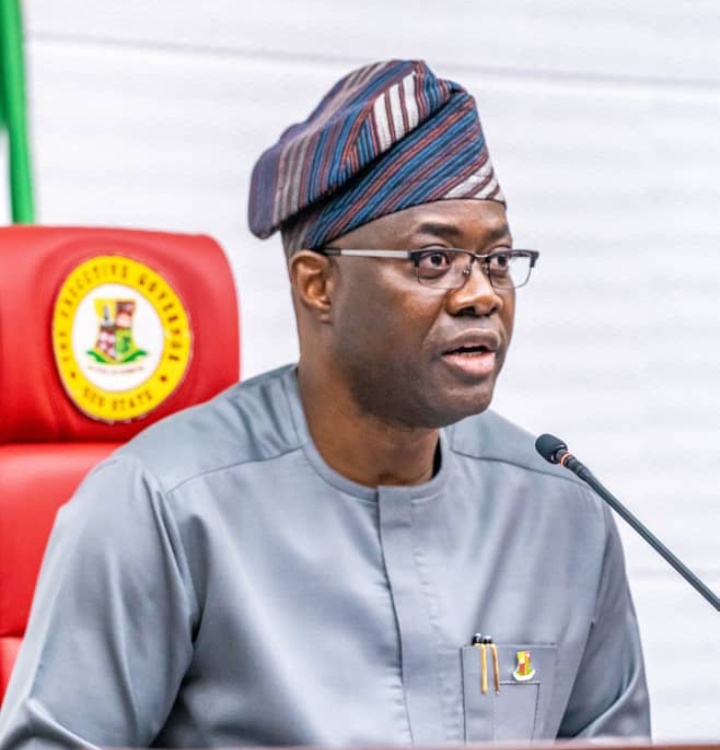
Mr Tunde Rahman is one of President Bola Tinubu’s many spokesmen. This is a rebuttal to his ‘Governor Makinde and His 2027 Gamble’ published across platforms on Sunday. We take the article as the response of the big man to the challenge from Ibadan.
Tunde Rahman’s article on Governor Makinde’s presidential aspiration wears the garment of commentary but carries the spirit of political anxiety. Beneath its dramatic language lies a familiar establishment discomfort: the fear that a younger, independent-minded politician may have come to disrupt carefully preserved hierarchies within Nigerian power politics.
The article attempts to portray Makinde’s presidential declaration as premature, opportunistic and structurally impossible. Yet much of its argument collapses under the weight of selective memory, weak assumptions and contradictions.
The first weakness is the suggestion that Makinde’s declaration is somehow illegitimate because the PDP remains in crisis. But since when has political turbulence become a disqualification for ambition? Nigerian political history teaches the exact opposite. Political actors often emerge precisely during periods of instability. Bola Tinubu himself did not wait for perfect calm before building alliances that eventually led to his presidency.
Politics is not conducted in laboratories of certainty. It is shaped in the chaos of ambition, negotiation and persuasion.
To therefore suggest that Makinde must wait until Tinubu takes his fingers off PDP before aspiring to national leadership is to impose on him a standard that no major Nigerian politician has ever obeyed. Besides, did Tinubu’s aide bother to check what the PDP/APM alliance means before raising that point?
More importantly, the article betrays an old Nigerian political habit: reducing democracy to entitlement mathematics. The writer invokes the argument on north south divide reportedly made by Senator Shehu Sani. He thinks this contest is a Yoruba contest. That such a divisive point came from the stable of the president can only be described as unfortunate. Who told the writer that his boss owns the entire eight years the south is entited to? At what coven was it allotted to him? Democracy dies the moment informal oligarchies begin to decide whose ambition is “allowed.”
The irony here is striking. The same political class that often lectures Nigerians about democracy frequently becomes uncomfortable when democracy behaves democratically.
Tinubu’s man also attempts to diminish Makinde’s political rise by insinuating that his declaration rally was an extravagant spectacle funded by taxpayers’ money. That accusation is casually thrown without evidence. By the way, till today, Tinubu’s presidency hasn’t replied to loud allegations that N800billion of taxpayers’ money was shoveled into President Tinubu’s 2027 election campaign. Money from the federation account.
The Tinubu presidency is unhappy at the success of Makinde’s Ibadan rally. Too bad. Nigerian politics thrives on symbolism, mobilisation and public theatre. The APC’s own presidential campaigns were massive carnivals of music, colour and logistics. Selective outrage becomes hypocrisy when standards apply only to opponents.
Besides, the Ibadan rally achieved what political declarations are designed to achieve: it announced seriousness, generated conversation and signalled organisational capacity. Politics is partly perception. A politician unable to demonstrate energy, confidence and mobilisation strength is already half-defeated before campaigns begin.
The Tunde Rahman article also tries to frame Makinde as a non-mainstream politician. Yet recent Nigerian political history repeatedly proves that political structures are fluid, not permanent. Alliances shift. Coalitions mutate. Yesterday’s outsider becomes tomorrow’s consensus candidate. Before 2013, few imagined that a fragmented opposition could unseat an incumbent president backed by state power. Yet 2015 happened. How many heavyweights supported Peter Obi in 2023 before he polled almost seven million votes? Tinubu himself emerged from the thorns and thistles of the hostilities of his own party.
And that historical memory matters because Rahman’s article subtly contradicts another argument advanced elsewhere within the same newspaper edition — that incumbency itself may no longer guarantee victory in Nigeria. If incumbency can be challenged, why should alternative aspirants be dismissed and abused merely for entering the arena?
There is also an undertone in the article that suggests Makinde should somehow remain confined to Oyo State politics. This is another recurring Nigerian problem: the attempt to provincialise ambitious leaders until they become politically harmless. Yet leadership is tested by expansion. Every national figure was once accused of overreaching. Obafemi Awolowo was once merely a Western Region leader. Nnamdi Azikiwe was once dismissed as a regional nationalist. Tinubu himself was once labelled only a Lagos politician. Ambition is the oxygen of politics.
The Tinubu presidency article further ignores a central fact about Makinde’s appeal: unlike many Nigerian politicians manufactured entirely by godfatherism, coercive patronage or inherited networks, Makinde’s rise carries the attraction of relative administrative performance. Even critics, include Tinubu’s Tunde Rahman, concede that his governance style in Oyo State projects calmness, infrastructural visibility and financial prudence. Whether one agrees with him politically or not, he has cultivated a reputation for measured governance in a political climate often dominated by noise and aggression.That reputation matters nationally.
Moreover, Rahman’s portrayal of Makinde’s “national unity” rhetoric as merely tactical misses the deeper crisis in Nigeria today. The country genuinely suffers from dangerous polarisation and increasing fears of democratic suffocation under dominant-party tendencies. Calls for coalition-building are therefore not abnormal; they reflect anxieties shared across political and civil society spaces.
The article’s greatest flaw, however, is its tone of premature finality. Nigerian politics has repeatedly humiliated prophets of certainty. Analysts declared Buhari unelectable until he won. They dismissed Peter Obi’s movement until it disrupted traditional calculations in 2023. They underestimated Tinubu’s resilience before the APC primaries. Nigerian politics remains gloriously unpredictable because voters, coalitions, crises and elite interests constantly rearrange themselves.
We understand the anxiety in Tinubu’s camp. They should blame themselves for taking Nigerians for granted. Which is why we laugh at Tinubu’s dismissal of Makinde’s aspiration in 2026 as dead on arrival.
Ultimately, the question is not whether Makinde will become president in 2027. That is for voters, parties and political realities soon to arrive to decide. The real question is whether Tinubu still believes in open democratic competition or whether his section of the elite now wish to pre-approve ambition before citizens are allowed to choose.
That is the deeper issue raised unintentionally by President Bola Tinubu’s Villa article.
And on that question, we sympathise with him. But it was all his fault. The politicians he bought cannot help him. The coming poll is between him and the hungry, deprived and marginalised Nigerian people.
*Alao is the Special Assistant (Print Media) to Oyo State Governor
